STANDARD 6 | Air transport of livestock
6.2.1 - Alpacas must not be sourced for export or exported unless they have a liveweight of 20kg or more and are at least 3 months old.
6.2.2 - Alpacas must not be sourced for export or exported unless they have been assessed by a competent stock handler against the alpaca body condition scoring in Table 24 and have a body condition score of 2 or more but less than 4 (on a scale of 1 to 5).
Table 24 Alpaca body condition score
Score | Description | Illustration |
1 | Severely concave between spine and ribs. The backbone is very noticeable, ribs are clearly felt and brisket shows no fat. | 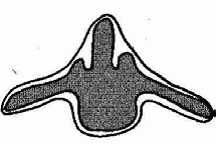 |
2 | Slightly concave between spine and ribs. You can feel backbone, ribs are noticeable and brisket is firm. | 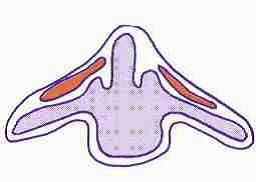 |
3 | Neither concave nor convex between spine and ribs. You can feel the backbone, but it does stand out and you can just feel the ribs and the brisket. | 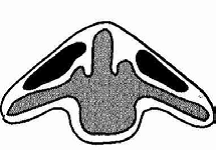 |
4 | Slightly convex between spine and ribs. You can feel the backbone, but it does not stand out and you can just feel the ribs and the brisket. | 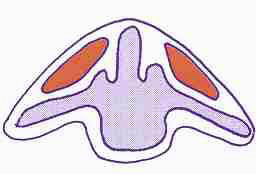 |
5 | Severely convex between spine and ribs, the top of the back feels flat. You cannot feel backbone or ribs, brisket wobbles when touched. | 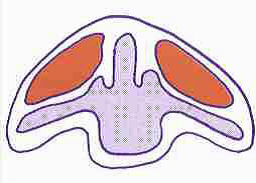 |
Source: Australian Alpaca Association
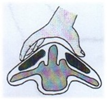
Figure 3 Visual aid for assisting with body condition scoring of alpacas
Source: Australian Alpaca Association
Figure 3 is an example of how to body score an alpaca by placing your hand on the backbone, just forward of the pelvic area (toward the last of the ribs).
6.2.3 - Female alpaca with a weight of 35 kg or more sourced for export as feeder or slaughter animals must be individually pregnancy tested using ultrasound within 30 days prior to export, by a registered veterinarian, who must provide pregnancy certification that the animal is not detectably pregnant.
6.2.4 - Female alpaca with a weight of 35 kg or more sourced for export as breeder animals must be no more than 227 days pregnant at the scheduled date of export, unless otherwise provided for in a last third of pregnancy management plan approved in writing by the department. Pregnancy testing must be performed by a registered veterinarian according to the following criteria:
- the test must be performed using ultrasound
- animals must be accompanied by pregnancy certification
- for not detectably pregnant alpaca, pregnancy certification is valid for 60 days from the date of the procedure.
6.2.5 - Alpacas must be penned in accordance with the minimum pen space allocation shown in Table 25. For weights between those shown in Table 25, the minimum pen area per head must be calculated by linear interpolation.
6.2.6 - When calculating pen allocation, the pen area per head must be increased by 10% for alpacas with more than 25mm of wool.
6.2.7 - Alpacas must have enough space to be able to cush during transport; that is sit with their legs folded underneath them.
Table 25 Minimum pen space allocation for alpacas exported by air
Liveweight (kg) | Minimum pen area (m2/head) |
20 | 0.238 |
30 | 0.311 |
40 | 0.377 |
50 | 0.436 |
60 | 0.492 |
70 | 0.545 |
80 | 0.595 |
90 | 0.643 |
100 | 0.689 |
110 | 0.734 |
120 | 0.778 |