STANDARD 6 | Air transport of livestock
6.4.1 - Camels must not be sourced for export unless they have become conditioned to being handled and to eating and drinking from troughs for a minimum of 14 days.
6.4.2 - Male camels that are more than 5 years of age and are in rut must not be exported in the period 1 May and 30 September (inclusive).
6.4.3 - Camels must not be sourced for export or exported unless they have been assessed by a competent stock handler against the camel body condition scoring in Table 28 and have a body condition score of 2 or more but less than 4 (on a scale of 1 to 5).
Table 28 Camel body condition score
Score | Description | Illustration |
1 | Little or no fat in the hump sac; hump hairy and may be leaning to one side; ischium, tuber coxae, shoulder, spinous and transverse processes of vertebrae very prominent; recto-genital zone very deep; hollow of flank very visible. | 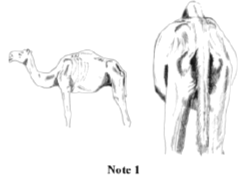 |
2 | Hump with moderate development rising 5% higher than chest depth, but may also be leaning to one side; ischium, tuber coxae, shoulder, spinous and transverse processes of vertebrae prominent; recto-genital zone deep; hollow of flank visible. | 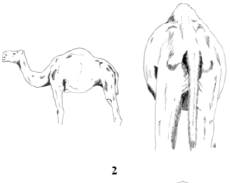 |
3 | Hump with good development and rising to 10% higher than chest depth. Hump is still sculptured inwards on both sides and still fits over the chest and abdominal area; ischium, tuber coxae, shoulder, spinous and transverse processes of vertebrae slightly prominent; recto-genital zone shallow; hollow of flank not visible. | 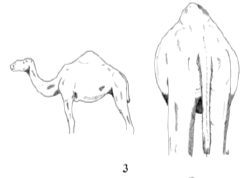 |
4 | Hump fully developed and rising to 15% higher than chest depth. Hump rounded outwards on both sides and runs from the shoulder to the rump; ischium, tuber coxae, shoulder, spinous and transverse processes of vertebrae not visible; recto-genital zone full of fat; hollow of flank not visible. | 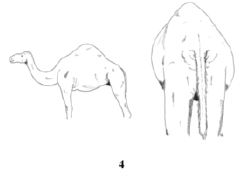 |
5 | Hump overextended and rising more than 15% higher than chest, or so full that it is rounded on the sides like a semicircle; ischium, tuber coxae, shoulder, spinous and transverse processes of vertebrae covered in fat; recto-genital zone bulging; ribs hollow of flank not visible. | 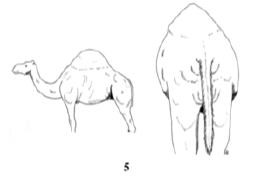 |
Source: The Central Australian Camel Industry Assoc. Inc.
6.4.4 - Female camels sourced for export as feeder or slaughter animals must be pregnancy tested using ultrasound within 30 days prior to export, by a registered veterinarian, who must provide pregnancy certification that the animal is not detectably pregnant.
6.4.5 - Female camels sourced for export as breeder animals must be no more than 250 days pregnant at the scheduled date of export, unless otherwise provided for in a last third of pregnancy management plan approved in writing by the department. Pregnancy testing must be performed by a registered veterinarian according to the following criteria:
- the test must be performed using ultrasound
- animals must be accompanied by pregnancy certification
- for not detectably pregnant camels, pregnancy certification is valid for 60 days from the date of the procedure.
6.4.6 - Camels sourced for export must meet transport and shipping height requirements of the intended transport, meaning that camels standing normally do not touch any overhead structures.
6.4.7 - Trained camels must be penned individually for air transport. Wild-caught camels are best transported in groups in pens such as cattle pens. Use of cattle pens must be limited to camels under 300kg liveweight.
6.4.8 - Camels over 300kg must not be sourced for export or exported unless otherwise provided in a camels over 300kg management plan approved in writing by the department.