STANDARD 6 | Air transport of livestock
6.3.1 - Buffalo must have been weaned at least 14 days prior to sourcing for export, unless the exporter has approval under Standard 6.1.17 to export livestock with young at foot.
6.3.2 - Buffalo must not be sourced for export unless they have become conditioned to being handled and to eating and drinking from troughs for a minimum of 21 days.
6.3.3 - Buffalo sourced for export must have an individual liveweight of between 150kg and 650kg (inclusive). Animals outside these weights must not be sourced for export or exported, unless:
- for buffalo less than 150kg, the exporter has approval under Standard 6.1.20 to export miniature or light weight breed livestock; or
- for buffalo more than 650kg, otherwise provided in a heavy buffalo management plan approved in writing by the department.
6.3.4 - Buffalo must not be sourced for export or exported unless they have been assessed by a competent stock handler against the buffalo body condition scoring in Table 26 and have a body condition score of 2 or more but less than 5 (on a scale of 1 to 5).
Table 26 Buffalo body condition score
Score 1 to 5 for export purposes | Description | P8 fat mm thickness | Loin surface | Illustration of vertical section of the loin region between spinous and traverse processes |
1 | Emaciated; very weak – extreme muscle wastage. All bones highly visible. Skin 'draped' over skeleton. Unsteady gait. | 0 | Severely concave | 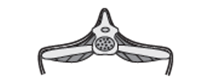 |
2 | Lean; short ribs visible, hook and pin bones still prominent. Can easily count all ribs. Some muscle depletion. No subcutaneous fat visible or palpable. | 0 | Moderately concave | 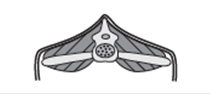 |
3 | Store; (average) good muscle definition, with fat starting to be deposited, rib outlines disappearing, hook and pin bones still defined. | 1 to 4 | Level, even slope | 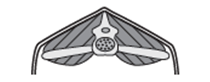 |
4 | Prime; quite even and smooth over whole backline. Muscling becoming more convex due to fat deposition. | 5 to 35 | Moderately convex | 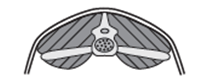 |
5 | Overfat; usually only mature cows can achieve this condition. Bulbous fat deposits both sides of tail head. Pin and hook bones not discernible. | >36 | Severely convex, crease/dip along spine | 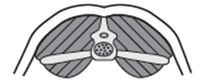 |
Source: NT Buffalo Industry Council Inc.
6.3.5 - Female buffalo sourced for export as feeder or slaughter animals must either be not detectably pregnant or be spayed according to the following criteria:
- pregnancy testing must be performed by a registered veterinarian within 30 days prior to export by either
- manual palpation
- an approved blood test
- ultrasound, or
- if spayed, the spay procedure must occur not less than 30 days prior to export if using the Willis dropped ovary technique or not less than 280 days prior to export if using any other technique, and
- animals must be accompanied by a spay declaration or pregnancy certification.
6.3.6 - Female buffalo sourced for export as breeder animals must be no more than 220 days pregnant at the scheduled date of export, unless otherwise provided for in a last third of pregnancy management plan approved in writing by the department. Pregnancy testing must be performed by a registered veterinarian according to the following criteria:
- using an approved blood test and if the test result is positive, undergo further testing as per b) or
- by manual palpation or ultrasound, and
- animals must be accompanied by pregnancy certification
- for not detectably pregnant buffalo, the pregnancy certification is valid for 60 days from the date of the procedure.
6.3.7 - Buffalo with horns must only be sourced for export or exported if they have:
- blunt horns; and
- horns that are less than the spread of the ears, unless otherwise provided in a long-horned livestock management plan approved in writing by the department.
6.3.8 - Buffalo must be penned in accordance with the minimum pen space allocation shown in Table 27. For weights between those shown in Table 27, the minimum pen area per head must be calculated by linear interpolation.
6.3.9 - When calculating pen space allocation, the pen area per head must be increased by 10% for buffalo with horns less than the spread of the ears.
Table 27 Minimum pen space allocation for buffalo exported by air
Liveweight (kg) | Minimum pen area (m2/head) |
150 | 0.54 |
160 | 0.56 |
170 | 0.58 |
180 | 0.60 |
190 | 0.62 |
200 | 0.64 |
210 | 0.66 |
220 | 0.68 |
230 | 0.70 |
240 | 0.72 |
250 | 0.74 |
260 | 0.76 |
270 | 0.78 |
280 | 0.80 |
290 | 0.82 |
300 | 0.84 |
310 | 0.87 |
320 | 0.89 |
330 | 0.91 |
340 | 0.93 |
350 | 0.95 |
360 | 0.98 |
370 | 1.00 |
380 | 1.02 |
390 | 1.04 |
400 | 1.06 |
410 | 1.08 |
420 | 1.10 |
430 | 1.12 |
440 | 1.15 |
450 | 1.17 |
460 | 1.19 |
470 | 1.21 |
480 | 1.23 |
490 | 1.25 |
500 | 1.27 |
510 | 1.29 |
520 | 1.31 |
530 | 1.34 |
540 | 1.36 |
550 | 1.38 |
560 | 1.40 |
570 | 1.42 |
580 | 1.44 |
590 | 1.46 |
600 | 1.48 |
610 | 1.50 |
620 | 1.53 |
630 | 1.55 |
640 | 1.57 |
650 | 1.59 |