STANDARD 1 | Sourcing and preparation of livestock for export by sea
1.4.1 - Cattle must have been weaned at least 14 days prior to sourcing for export.
1.4.2 - Cattle sourced for export must have an individual liveweight of 200kg to 500kg. Animals outside of these weights must not be sourced for export or exported, unless otherwise provided:
- for cattle less than 200kg, in a light cattle management plan approved in writing by the department, and cattle must have an individual liveweight of 200kg or more at the time of export; or
- for cattle more than 500kg, in a heavy cattle management plan approved in writing by the department.
1.4.3 - Bos taurus cattle sourced for export from any area of Australia south of latitude 26°S must only be exported on voyages that cross the equator and depart between 1 May and 31 October (inclusive) if:
- they have been determined in accordance with the conditions in Standard 1.4.5, or Standard 1.4.6 and Standard 1.4.7, to be not detectably pregnant, unless otherwise provided in a pregnant southern sourced Bos taurus cattle crossing the equator from May to October management plan approved in writing by the department; and
- for cattle to or through the Middle East, a HSRA indicates that the risk is manageable (less than 2% risk of a 5% mortality).
1.4.4 - Cattle must not be sourced for export or exported unless they have been assessed by a competent stock handler against the cattle body condition scoring in Table 2a (non-dairy breed cattle) or Figure 2a (dairy breed cattle) and have:
- for non-dairy breed cattle, a body condition score of 2 to 4 (inclusive) (on a scale of 0 to 5), unless they are Bos taurus cattle sourced for export from, or exported through, any area of Australia north of latitude 26°S between 1 October and 31 December (inclusive), then they must have a body condition score of 2 to 3 (inclusive) (on a scale of 0 to 5);
- for dairy breed cattle, a body condition score of 3.5 but less than 5.5 (on a scale of 1 to 8), unless they are Bos taurus cattle sourced for export from, or exported through, any area of Australia north of latitude 26°S between 1 October and 31 December (inclusive), then they must have a body condition score of 3.5 or more but less than 5 (on a scale of 1 to 8).
Table 2 [deleted]
Table 2a Non-dairy breed cattle body condition score
Score | Description |
0 | Severely emaciated |
1 | The individual bones are sharp to the touch, with no fat at the head of the tail. Hip bones and ribs are prominent. |
2 | The individual bones can be felt easily, but feel rounded rather than sharp. There is some tissue cover around the tail head. Individual ribs are no longer visually obvious. |
3 | The short ribs can be felt only with firm thumb pressure. Areas either side of the tail head have fat cover that can be felt easily. |
4 | The ribs cannot be felt and fat cover around the tail head is easily seen as slight mounds, soft to touch. Folds of fat are beginning to develop over the ribs and thighs. |
5 | The bone structure of the animal is no longer noticeable and the tail head is almost completely buried in fatty tissue. |
Source: Cattle Council of Australia
Figure 2a Dairy breed cattle body condition score (diagram shows 3 to 6 on scale of 1 to 8)
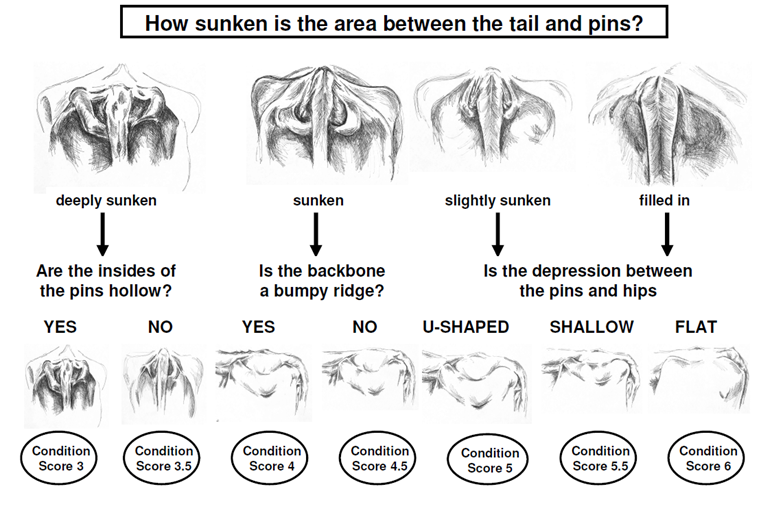
Source: DEPI (Vic)
1.4.5 - Female cattle sourced for export as feeder or slaughter animals must either be not detectably pregnant or be spayed according to the following criteria:
- pregnancy testing must be performed by a registered veterinarian or competent pregnancy tester within 30 days prior to export (unless the exporter has approval under Standard 1.4.7) by either
- manual palpation
- an approved blood test if performed by a registered veterinarian
- ultrasound if performed by a registered veterinarian, or
- if spayed, the spay procedure must occur not less than 30 days prior to export if using the Willis dropped ovary technique or not less than 280 days prior to export if using any other technique, and
- animals must be accompanied by a spay declaration, pregnancy declaration or pregnancy certification.
1.4.6 - Female cattle sourced for export as breeder animals must be no more than 190 days pregnant at the scheduled date of discharge in the importing country and must be pregnancy tested by a registered veterinarian according to the following criteria:
- using an approved blood test and if the test is positive, undergo further testing as per b) and c), or
- if the voyage is less than 10 voyage days, be pregnancy tested using manual palpation or ultrasound, or
- if the voyage is 10 voyage days or more, be pregnancy tested by a PREGCHECK-accredited veterinarian using manual palpation or ultrasound, and
- animals must be accompanied by pregnancy certification.
1.4.7 - Pregnancy declaration or pregnancy certification is valid from the date of the procedure or collection of blood sample for a period of:
- 30 days for feeder and slaughter cattle, unless an exporter has applied for a declaration or certification validity extension and received approval in writing from the department
- 45 days for pregnant breeder cattle unless an exporter has applied for a certification validity extension and received approval in writing from the department
- 60 days for not detectably pregnant breeder cattle.
1.4.8 - Cattle with horns must only be sourced for export or exported if the solid non-vascular tip has been removed to a diameter of 3cm (or less if the horn vasculature does not allow) and horns have a blunt horn end; and
- horns are no longer than 12cm in length at the time of export, unless otherwise provided in a long-horned livestock management plan approved in writing by the department; or
- horns are longer than 12cm in length at the time of export and are pointing downwards parallel to the face and do not show signs consistent with the rejection criteria specified in Table 1.